

Moles

What is/are Moles?
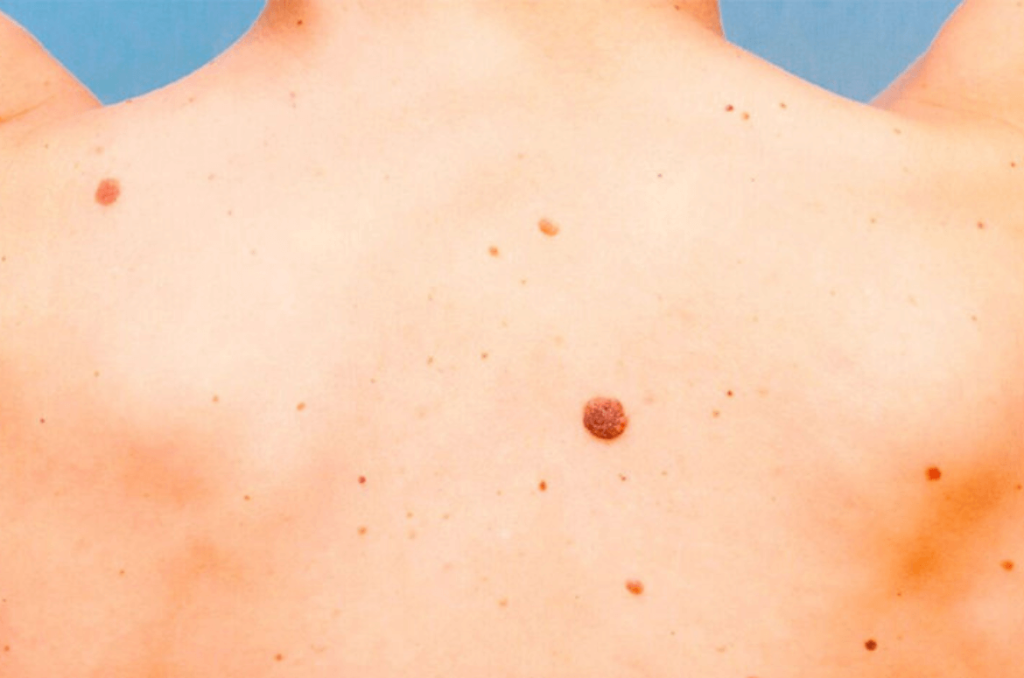
Moles are a common type of skin growth that can occur on any part of the body. Many people use the term “beauty mark”. The medical term for moles is melanocytic naevi. They often appear as small, dark brown spots. Moles generally appear during childhood and adolescence. Most adults have 10 to 40 moles on their body. Some moles may change in appearance or fade away over time. Most moles are often harmless however, a small proportion become cancerous. Monitoring moles and other pigmented patches is an important step in detecting skin cancer, especially malignant melanoma.
What causes Moles?
Moles are caused when cells in the skin (melanocytes) grow in clusters or clumps instead of being spread throughout the skin. Melanocytes are distributed throughout your skin and produce melanin. Melanin is a natural pigment that gives our skin its colour. The more melanin we have the darker is our complexion. Genetic inheritance and sun exposure are the major factors determining the number of moles we have. Moles appear in all races and skin colour. Moles may darken after exposure to the sun, during the teen years and during pregnancy.
What do they look like?
The typical mole is a brown or black oval or round spot. But moles come in different colours, shapes and sizes. Moles may be smooth, wrinkled, raised or completely flat. They may have hair growing from them. Some moles become darker with sun exposure or pregnancy. Moles are found more commonly on areas of sun exposure. Hence, the face arms and back are commonly affected. Most moles are less than 6mm in diameter which is a size of a pencil eraser. Rarely, moles present at birth (congenital nevi) can be much bigger, covering wide areas of the face, torso or a limb.
How can they be treated?
Regular moles pose essentially little to no health risk. It is not necessary to remove all moles. The vast majority of moles are not cancerous and generally do not become cancerous. However, it may be necessary to remove and examine any moles that are changing, growing, new, symptomatic, or bleeding. Periodic monitoring and medical evaluation of moles is important to help determine which moles need to be removed. Removal of moles can be carried out using different techniques. Although lasers are used to remove some types of moles, laser treatments are not recommended for moles. Irregular moles need to be surgically removed and the tissue sent for testing. While sun spots or lentigines may respond to bleaching or fading creams, freezing with liquid nitrogen, laser, intense pulsed light, and chemical peels, true melanocytic nevi should not be treated by these methods.
What are the three basic types of moles?
Three basic types or groups of moles are: regular and symmetrical, irregular, and cancerous. Atypical mole is another term for an irregular mole. Regular moles are typically benign and harmless. Regular moles are usually symmetrical, have regular borders, uniform colour, and are about the size of a pencil eraser or smaller. Regular moles may be flat or raised. The presence of hair growing from a mole is unrelated to its cancer potential.
Irregular or atypical moles are usually asymmetrical, with irregular borders, multiple colours, and tend to be bigger than the size of a pencil eraser. Irregular moles are often flat or nearly flat. Having more than 20-25 irregular moles may increase the person’s overall risk of developing melanoma. The presence of a giant congenital mole greater than approximately 8-10 inches in size also may confer an increased risk of melanoma. Irregular moles signal the potential for developing melanomas over time. Irregular moles themselves rarely turn into melanoma or cancer.
Cancerous moles called melanomas, are highly irregular and are often asymmetrical. Rarely, regular moles may evolve into a melanoma over time. It is important to watch all moles closely for change or atypical features. In those with greater than 50 moles or several abnormal moles, monthly skin self-examinations and at least annual full-body moles exam by a dermatologist are important in the early detection of abnormal moles and melanoma.
Irregular moles can occur anywhere on the body but are most commonly located on sun-exposed skin, especially on the upper back and shoulders where people frequently get their most severe sunburns. The risk of melanoma is greater on chronically sun-exposed skin like the shoulders, upper back, head, and neck.
Does having more moles increase one's chance of getting melanoma?
The total number of irregular moles on one’s body is one of the strongest indicators for the risk of developing a malignant melanoma. There is also a direct relationship between the number of innocent moles on the skin and the chance of developing an abnormal or changing mole. The more moles a person has, the greater the risk of developing atypical moles and potentially melanoma.
Is there scarring after mole removal?
When the skin is cut, there will be some type of scaring produced by the healing process. Some people heal better than others. The larger the mole the larger the scar. Some scars are more noticeable depending on their location and skin type. Moles on the back tend to leave more prominent scars. African patients are at a greater risk of developing raised(hypertrophic) and keloid scars. There are many options for treatment of surgical scars, including lasers, scar creams and gels, cortisone injections, and many other choices depending on the scar. Dr Kentse will discuss ways of minimising scarring.
Can I have multiple moles removed at the same time?
It is possible to have multiple moles removed at the same sitting. The number of moles removed at one time will be dependent on the size of the moles and amount of local anaesthesia required. The decision to remove multiple moles will be at the discretion of the doctor.
Can my mole grow back after removal?
If a common mole is removed completely, it should not grow back. However, some mole cells may be left behind after mole removal surgery and may recur in the same or adjacent area. It is important to understand that no surgery has a100% cure rate. Atypical moles or moles in high risk areas may need closer follow up after removal. To avoid regrowth, be sure to talk to Dr Kentse about your mole removal options.
Contact Info
Dr Kentse works from two locations.
Get In Touch
Please fill in the form below to request an appointment.